
How to Choose the Right Foundation for Your Manufactured Home
Manufactured Homes vs Modular Homes – What is the Difference?
| Modular Home | Manufactured Home |
|
|
sources: Modular Today, River Bank Finance

Pictured: Modular Home vs. Manufactured Home / Image Credits: Tidewater Mortgage Services, Inc.
HUD, FHA Financing, and You
Why do these definitions matter? Well, as mentioned previously, the Federal Housing Administration (FHA) and the U.S. Department of Housing and Urban Development (HUD) classifies these two types of homes into separate categories. This means that the type and amount of financing available differs between them. Currently, the maximum amount that a homeowner can borrow is $93,000 for a manufactured home, which includes both the lot and home. It also means that manufactured homes have a different set of rules and regulations that they must conform to.
In order for a manufactured home to qualify for FHA financing, it must meet the safety standards laid out by HUD in the National Manufactured Housing Construction and Safety Standards Act of 1974. This act “issues and enforces appropriate standards for the construction, design, performance, and installation of manufactured homes to assure their quality, durability, affordability, and safety.” In order to be HUD Compliant, a manufactured home must have:
- A Certification label (also called a HUD tag) which certifies that the manufacturer of the home built it in accordance with HUD codes of safety.
- A Data plate which outlines miscellaneous information about the home, such as the model number, equipment included with the home, and environmental conditions that the home was built for.
- A Serial Number, or the equivalent of your home’s VIN number.
Additionally, the foundation of the home must meet separate requirements set by HUD in PERMANENT FOUNDATIONS GUIDE FOR MANUFACTURED HOUSING (4930.3G). The general material and quality standards for foundations accepted by HUD are outlined in Chapter 5 of the Permanent Foundations Guide. A structural engineer will have to inspect and sign off on things like planned foundation materials, excavation depths, minimum foundation wall thickness, crawl space requirements, and other environmental challenges that may affect the construction or maintenance of the foundation.
Types of Foundations
There are two main categories of manufactured home foundations – permanent and non-permanent. These classifications can be confusing though, as HUD does not necessarily make this distinction. Permanent foundation as defined by HUD:
“Permanent foundations must be constructed of durable materials; i.e. concrete, mortared masonry, or treated wood – and be site-built. It shall have attachment points to anchor and stabilize the manufactured home to transfer all loads, herein defined, to the underlying soil or rock. The permanent foundations shall be structurally developed in accordance with this document or be structurally designed by a licensed professional engineer…”
This does not touch on the ability to move the foundation, which seems to be the basis for the Permanent/Non-Permanent classifications. For example, slab foundation is considered a non-permanent foundation because it can be relocated. However, slab foundations can be permanently attached to the home, which can classify them as permanent for the purposes of financing and real-estate as long as they meet state and local building codes and are approved by an engineer. In short, what is considered a permanent foundation can vary by location, thus a homeowner should research state and local regulations as well as consult a foundation engineer before making a final decision. To hopefully avoid some confusion, the terms Mobile and Immobile will be used in place of Non-Permanent and Permanent, respectively.
- Permanent or Immobile Foundations:
These types of foundations cannot be removed or relocated, and there are many standards and building codes that must be met in order to construct and certify it. Immobile foundation options are always the most expensive, but they directly increase the resale value of the home and property. They also have a slower depreciation value, they give the homeowner a much higher chance of qualifying for financing through the FHA, and they can provide more complete protection against environmental factors which can save on home repair costs in the long run. Immobile foundations are suggested for homeowners who are not planning on moving their manufactured home.
|
Name of Foundation |
Notes |
Pros |
Cons |
|
Basement |
Most expensive option, but also has the best chance of financing and best resale value. The home also gains another living space. |
|
|
|
Pit |
Very similar to basement foundation for financing and real-estate classification. |
|
|

Pictured: Builders constructing a basement foundation / Image Credits: Home Set Construction, Inc.
- Non-Permanent or Mobile Foundations:
As implied, these types of foundations are able to be removed and relocated, which can be convenient if the homeowner does not own the land, or if they plan on moving at some point. However, they are sometimes much harder to get approved for FHA financing.
|
Name of Foundation |
Notes |
Pros |
Cons |
|
Slab |
This is, as you may have guessed, one large slab of poured concrete. |
The simplest type of foundation Its simplicity makes it easy and quick to install Cheap Can be transported Can add crawl space |
If the slab is not insulated, the home may not meet certain real-estate requirements Has potential to cause damage to any piping or plumbing that may run through Cannot be used if there is a slope |
|
Runner |
Most are comprised of concrete, steel frames, or both. |
Generally the cheapest option Does not pose risk to pipes or plumbing |
Cannot be used if there is a slope Most easily damaged of all foundations |
|
Pier (or Footer) |
Steel jacks and stacks of concrete blocks rest on small concrete slabs under the home’s support beams. It may be difficult to attain a real-estate classification for the home and property with this type of foundation. |
Similarly priced as the runner foundation Can add crawl space Unlike other foundations, it is resistant to freezing and flooding |
Home can become non-levelled Aesthetically displeasing Hard to attain real-estate status unless the home is permanently attached to the piers |
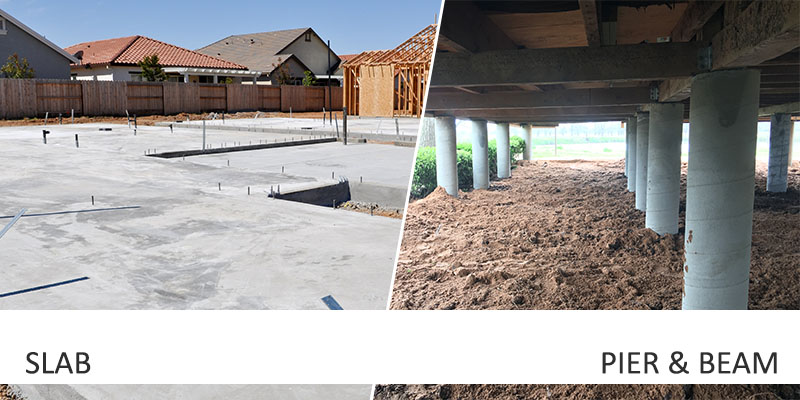
Pictured: Slab vs. Pier & Beam foundations / Image Credits: Ecoscape Foundation & Home Services
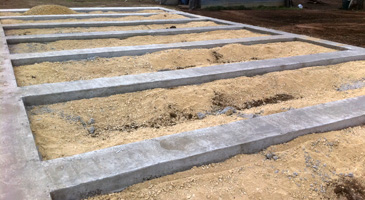
Pictured: Runner foundation / Image Credits: Alamo Transport & Development
Summary
To give a homeowner the best possible chance of being financed, it is important that they choose the right engineers and inspectors to ensure that the home and its foundation is completely up to code. Hayman Engineering, Inc. is a full-service engineering firm “who can provide whatever service you need from engineering certifications for mortgage qualifications to repair damaged foundations.” With regional locations in Mississippi, Missouri, Tennessee, and Virginia, as well as a national network of over 1,500 inspectors and hundreds of contractors, Hayman Engineering, Inc. is ready to meet the engineering needs of homeowners everywhere.
